
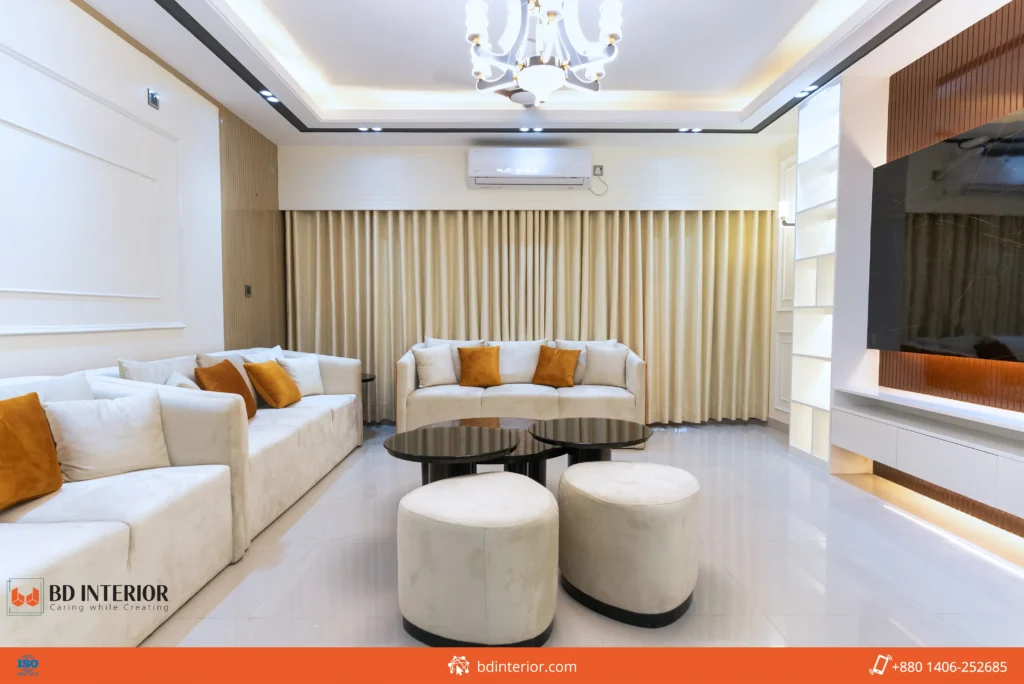
Most Dhaka apartment owners don’t realize that the single most expensive decision isn’t the sofa fabric; it’s the wall they didn’t plan storage onto. Or the walkway that narrowed to 22 inches because the furniture layout was never measured.
Custom apartment interior design in Dhaka isn’t about making a flat look glossy. It’s about fixing the things that make daily life feel cramped, dark, and disorganized. In a city where 1,000-square-foot flats often need to house four people, work-from-home setups, and a full kitchen, every inch matters.
The short version
- Custom apartment interior design in Dhaka prioritizes built-in storage, lighting, and space planning, not just decoration. Starting with a proper layout prevents expensive furniture mistakes.
- Full design and execution typically costs BDT 1,500 to 3,000 per sq ft, with premium options going up to BDT 5,000+. A 1,000 sq ft flat can range from BDT 12 lakh to 50 lakh based on scope.
- Warm modern minimalism with hidden storage, layered lighting, and nature-linked touches like balcony plants are the trends that actually work for compact Dhaka apartments.
Key Point
- The biggest payoff in a Dhaka flat comes from vertical storage, built-in wardrobes, tall kitchen cabinets, and wall-mounted TV units, not from expensive loose furniture.
- Layout planning must happen before false ceiling or paint color decisions. A sofa that blocks the 32-inch circulation path makes even a beautiful living room feel stressful.
- Design-only services (BDT 50–80 per sq ft) are separate from full execution; mixing up those numbers is where most budget misunderstandings start.
Table of Contents
- What Is Custom Apartment Interior Design in Dhaka, Really?
- How Much Does a Custom Interior Actually Cost in Dhaka?
- The Biggest Layout Mistakes That Waste Space (And How Smart Designers Fix Them)
- People Also Ask
- Conclusion: Making Your Dhaka Flat Work Harder
What Is Custom Apartment Interior Design in Dhaka, Really?
Custom apartment interior design in Dhaka means planning every fixed element– storage, lighting, electrical points, false ceilings- around the specific dimensions and habits of your flat, instead of copying a catalogue. It’s not the same as decorating. Decorating is what you do after the walls are up and the wiring is hidden. Custom interior design happens before all that, when you’re deciding where the light switch goes relative to the bed, or how deep the TV cabinet can be without choking the walkway. In a typical Dhaka flat with fixed beams, narrow kitchen galleries, and shared living-dining zones, that precision is what separates a home that breathes from one that frustrates.
Most Dhaka apartments in Gulshan, Dhanmondi, Mirpur, or Uttara face the same structural realities. You can’t move the window. You can’t delete the column in the corner. What you can do is build storage around them, direct light where it’s needed, and create furniture proportions that don’t fight the room.
Studio Archifiction puts it plainly: “Our working range for a full apartment interior in Dhaka, design and execution together, is BDT 1,500 to 3,000 per sft.” That range covers everything from initial measurement to final handover, and it’s a number that frames how Dhaka firms define the service.
Is custom design only for luxury flats?
No, custom design scales. A 950 sq ft flat can benefit just as much as a 2,500 sq ft one. The difference is in the scope. A smaller flat might invest more in vertical storage and multi-use furniture, while a larger flat might allocate budget to layered lighting or better veneer.
The principle stays the same: the design is built around your daily routine, not a showroom template. And that includes small balconies, prayer corners, or study nooks that standard packages often ignore.
Here’s a key shift. As of 2026, warm modern minimalism is what more Dhaka interior firms are pushing. The Daily Star recently noted, “2026 brings Warm Modern Minimalism.
Clean lines, hidden storage, uncluttered surfaces.” That’s not just a style choice; it’s a practical response to compact spaces. Hidden storage keeps visual noise down, and clean lines make a small room feel larger. It’s a look that works especially well in humid Dhaka, where clutter traps dust and makes maintenance harder.
How Much Does a Custom Interior Actually Cost in Dhaka?
Industry data shows full apartment design and execution in Dhaka falls between BDT 1,500 and 3,000 per sq ft, with design-only fees around BDT 50 to 80 per sq ft, rising to BDT 100 for complex projects. A 1,000 sq ft flat can cost anywhere from BDT 12 lakh to 50 lakh total, depending on whether you need only design drawings, partial execution, or a complete out-of-the-box job that includes electrical, false ceiling, custom joinery, and site supervision. The spread is wide, but it’s driven by three things: scope, material grade, and the number of built-in cabinets.
If you’re still figuring out what a reasonable budget looks like, it helps to think in tiers. Below is a comparison that reflects what multiple Dhaka firms currently quote.
| Package Level | Cost per Sq Ft | Typical Inclusions | Best For |
|---|---|---|---|
| Basic | BDT 1,200 – 1,800 | Laminate finishes, standard tile, simple false ceiling, functional lighting | First-time owners who need a clean, livable base |
| Standard | BDT 1,800 – 2,800 | Better plywood, HPL finishes, accent lighting, detailed TV wall, optimized wardrobe design | Families who want durable storage and a polished look |
| Premium | BDT 3,000 – 5,000+ | Imported veneer, soft-close hardware, custom joinery, designer lighting, engineered wood flooring | Owners who prioritize long-term quality and are willing to pay for material longevity |
A quick bar chart gives you a clearer sense of how these tiers compare by cost per square foot:
Approximate Mid-Range Cost per Sq Ft by Tier (BDT)
Why do premium packages cost that much more?
Because the joinery changes. Every wardrobe, every kitchen cabinet, every vanity is built to the exact wall it sits against, no filler panels, no dead gaps. The hardware is soft-close, the edge banding is thicker, and the veneer is imported. A flat with three full-height wardrobe walls costs more than the same flat with two, regardless of area.
Lighting also becomes layered and separately controlled, which requires more circuits and more planning. These aren’t cosmetic upgrades; they’re structural differences that show after three years of daily use, when the drawers still slide smoothly, and the laminate hasn’t peeled at the edges.
What’s the cheapest way to get a custom look without going broke?
Spend on vertical storage and lighting, save on loose furniture. Built-in wardrobes and a well-planned kitchen give the most daily impact. You can add side tables and decor later. A design-only service (BDT 50–80 per sq ft) gives you a professional plan that you can execute gradually, which cuts upfront cost without sacrificing the layout logic.
The Biggest Layout Mistakes That Waste Space (And How Smart Designers Fix Them)
Poor layout flow and weak storage planning are recurring complaints in Dhaka apartment discussions. People keep saying the same thing: the sofa looked right in the showroom, but at home it blocks the path from the entrance to the dining table. Or the bedroom wardrobe is so deep that only 18 inches remain between the bed and the wall. These mistakes are avoidable, but they happen because most owners start with finishes instead of measurements.
A common failure pattern: the dining area gets squeezed after furniture arrives. It looked fine on paper, but nobody measured the chair pull-out space. You need at least 36 inches from the table edge to the wall for comfortable movement. Less than that, and someone’s always bumping into the sideboard.
Another classic: the living room becomes a walking passage because the sofa is too deep and the coffee table is too wide. A right-sized sofa, a slim TV unit, and built-in storage often work better than heavy loose furniture. And when you’re planning a drawing room that doubles as a guest space, checking out small drawing room ideas that keep the room flexible can help you avoid buying pieces that dominate the floor.
How do you fix a cramped bedroom without knocking down walls?
Use a full-height wardrobe on one wall only, and keep the area around windows clean. A work corner can be integrated without clutter if the desk is wall-mounted and cable management is planned early. In one Agargaon Residence project, the master bedroom included a built-in work nook that didn’t steal floor space, it used the depth of the wardrobe wall to create a recessed desk. That’s the kind of thinking that turns a 10-foot-wide bedroom into a functional dual-purpose room.
Does integrated storage really solve day-to-day clutter?
Yes. Integrated storage gets strong approval from Dhaka flat owners because it hides the stuff that otherwise piles up on surfaces. A wall-mounted TV unit with concealed cabinets, a tall pantry beside the fridge, a slim shoe cabinet near the entry- these are the details that make a flat feel organized even when life gets messy. And when you’re comparing options for a complete flat makeover, understanding the full scope of flat interior design in Bangladesh gives you a better sense of what’s possible within your square footage.
People Also Ask
How long does custom interior design take for a Dhaka apartment?
Most full-scope projects take about 8 to 14 weeks from design approval to handover. The timeline depends on the amount of custom joinery and whether civil changes are needed. Design-only phases can finish in 2 to 3 weeks.
Can I do custom interior design in phases to manage costs?
Yes, many owners start with design drawings and then execute room by room. The kitchen and master bedroom usually come first because they affect daily comfort the most. A phased approach spreads the financial load without compromising the overall plan.
What materials hold up best in Dhaka’s humidity?
Plywood with high-quality laminate or HPL finishes, low-VOC paints, and engineered wood flooring perform better than solid wood in humid conditions. Bamboo and jute accents also work well for decorative elements because they breathe and resist mold if treated properly.
Is it worth hiring an interior designer for a small flat under 1,000 sq ft?
Absolutely. Small flats benefit the most from professional space planning because there’s no margin for error. A designer can spot opportunities, like borrowing depth from a wardrobe wall for a desk, that an untrained eye would miss.
Do designers in Dhaka handle balcony and utility spaces too?
Yes, many include balcony seating, plant arrangements, and utility cabinet design as part of the scope. Users and homeowners often like nature-linked ideas such as balcony plants and small green corners because they make dense urban homes feel fresher.
Conclusion
Custom apartment interior design in Dhaka isn’t a luxury add-on. It’s the difference between a flat that tolerates your life and one that makes it easier. The numbers are clear: you can get a smart, livable home starting around BDT 1,500 per sq ft if you prioritize storage and lighting over decorative frills. But the real value comes from what you don’t see: the 32-inch walkway that stays clear, the wardrobe that uses the full wall height, the light switch that’s exactly where your hand reaches in the dark.
Before you talk to any firm, measure your worst daily frustration. Is it the dark kitchen counter? The shoes piled near the door? The dining chair that always hits the wall?
Those are your design brief. Then, when you’re ready to compare firms, take a look at how to find the best home interior design company in Bangladesh so you know what questions to ask about supervision, warranty, and material sourcing. If budget is your main concern, breaking down interior design costs in Bangladesh will help you see where the money really goes.
- Measure your circulation paths, Check that main walkways are at least 32 inches wide before buying any furniture.
- List your storage pain points, Identify the three areas where clutter accumulates daily and plan built-in solutions for each.
- Separate design and execution budgets, Get quotes for design-only first, then decide how much execution you can fund upfront.
- Finalize lighting before the false ceiling, Decide task and ambient light positions, then drop the ceiling only where needed for AC and lights.